
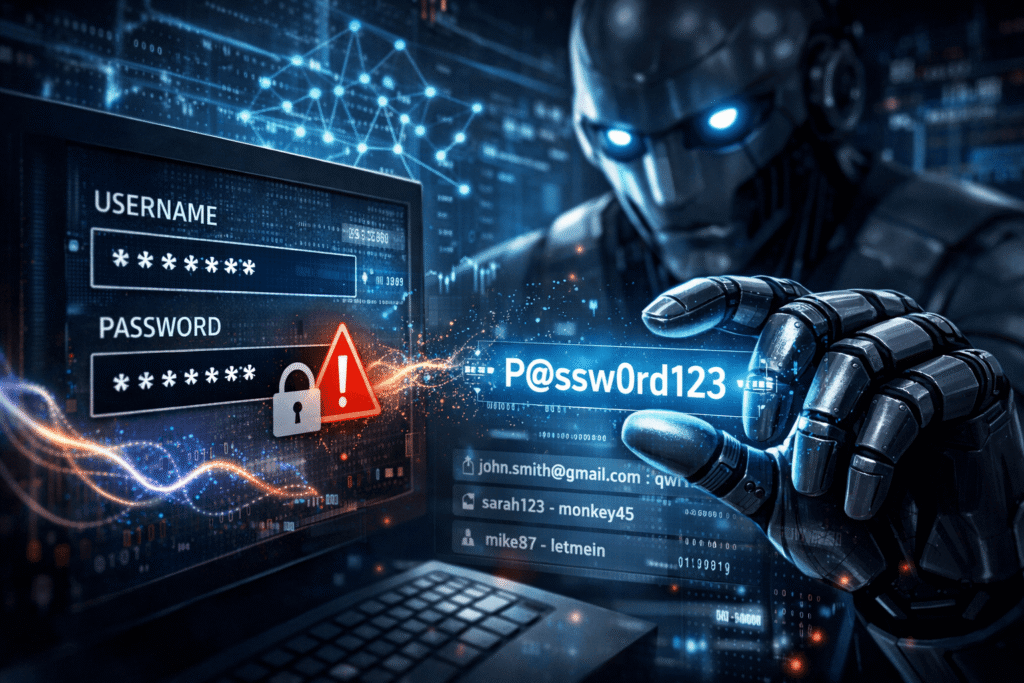
Yes, AI can be used to steal passwords. Cybercriminals use AI for brute-force attacks, credential stuffing, spear phishing, and OSINT-driven password guessing — dramatically reducing the time to crack weak or reused passwords. Protecting yourself requires unique, long passwords for every account, a password manager, multi-factor authentication, and vigilant personal privacy habits online.
In 2023, researchers at Home Security Heroes fed 15.6 million real-world passwords into an AI password-cracking tool called PassGAN — and the results were alarming. The AI cracked 51% of common passwords in under one minute. Passwords of seven characters or fewer? Cracked instantly. Even a twelve-character password consisting only of lowercase letters was cracked in under two minutes. This was not a classified government supercomputer — it was a commercial AI model running on readily available hardware.
The question “can AI steal passwords?” is no longer hypothetical. AI password hacking is an active and escalating cybersecurity threat that is reshaping how criminals attack digital accounts — and how security professionals must defend them. AI has not simply made old attack techniques faster; it has enabled entirely new categories of credential theft that exploit human psychology, public data, and the staggering scale of leaked password databases.
This guide provides a comprehensive, research-backed breakdown of AI-powered password attacks: the specific techniques attackers use, the real-world statistics that define the threat, and the concrete, expert-recommended steps individuals and organizations can take to protect their accounts. Whether you’re securing a personal email account or hardening enterprise authentication infrastructure, understanding AI cybersecurity risks is now a prerequisite for anyone who relies on passwords — which is essentially everyone.
Can AI Be Used to Crack Passwords?
Yes — and it is happening right now, at scale. Artificial intelligence has fundamentally altered the economics and effectiveness of password cracking. Traditional brute-force attacks required enormous computational resources and were constrained by the sequential nature of password guessing. AI removes those constraints in three critical ways: it learns probabilistic patterns from leaked password datasets, it personalizes attack strategies using open-source intelligence, and it automates the entire attack lifecycle from reconnaissance to credential exploitation.
The technical foundation is generative adversarial networks (GANs) and large language models trained on real-world password databases. Tools like PassGAN — built on a GAN architecture — learn the statistical distributions of how humans actually create passwords. Rather than guessing “aaaaaa, aaaaab, aaaaac” sequentially, AI-powered crackers generate high-probability candidates that reflect real human patterns: dictionary words with number suffixes, common letter substitutions (“p@ssw0rd”), first names followed by birth years, and keyboard walk patterns like “qwerty123”.
KEY RESEARCH: The 2023 PassGAN study by Home Security Heroes found that AI cracked 51% of common passwords in under 60 seconds, 65% within one hour, and 71% within one day. Passwords under 10 characters were almost universally cracked within 24 hours regardless of character set. Only passwords of 18+ characters with mixed character sets resisted AI cracking beyond one month.
Beyond password cracking tools, AI enables credential theft through three additional vectors that did not exist at meaningful scale five years ago: AI-powered phishing that bypasses human detection, OSINT-driven personal password inference, and automated credential stuffing at previously impossible scale. Each of these is explored in detail in the following section.
The question is not whether AI is being used to hack passwords — it unquestionably is. The more useful question is which specific techniques pose the greatest risk to your accounts and what defenses are actually effective against AI-powered attacks. The good news is that well-implemented defenses remain highly effective; the bad news is that most people and organizations have not implemented them.
How Can Hackers Use AI to Steal Passwords?
AI has transformed password hacking from a blunt-force discipline into a precision intelligence operation. Modern AI-powered attacks are multi-stage, personalized, and automated — combining technical password cracking with psychological manipulation and mass-scale data exploitation. Understanding these techniques is the first step in building effective defenses against them.
The primary AI-powered attack techniques used against passwords in 2026 include:
- Brute-force and dictionary attacks powered by generative AI: Traditional dictionary attacks rely on static wordlists. AI-powered equivalents use GAN and transformer models trained on billions of leaked passwords to generate statistically likely candidates in real time, dramatically outperforming rule-based approaches.
- Credential stuffing at AI scale: AI automates the testing of leaked username-password combinations across hundreds of sites simultaneously, using rotating proxies and behavioral mimicry to evade bot detection systems.
- AI-enhanced spear phishing for credential harvesting: LLMs generate hyper-personalized phishing emails, texts, and voice calls that convincingly impersonate trusted contacts or institutions — tricking victims into voluntarily surrendering passwords.
- OSINT-driven personal password inference: AI analyzes publicly available data about a target — social media posts, public records, professional profiles — to infer likely password elements such as pet names, anniversaries, and favourite sports teams.
- Keylogger and malware deployment via AI-generated social engineering: AI crafts convincing pretexts for malware delivery — fake software updates, weaponized documents, or fraudulent app downloads — that install keyloggers or credential-harvesting tools on victim devices.
- Acoustic and side-channel attacks: Emerging AI research has demonstrated the ability to infer typed passwords from audio recordings of keyboard sounds, with accuracy rates above 90% in controlled conditions (British researchers, 2023).
Automate the Creation and Execution of Spear Phishing Attacks
Phishing has always been the most cost-effective method of password theft — and AI has made it dramatically more effective. Traditional phishing relied on generic, mass-distributed emails that trained users could often identify by poor grammar, generic salutations, and implausible scenarios. AI phishing attacks are qualitatively different because they eliminate those tells.
Using large language models, attackers can generate personalized phishing emails that reference the recipient’s actual employer, manager’s name, recent company news, and communication style — all harvested from public sources in seconds. The email might appear to come from IT support requesting an urgent password reset, a trusted vendor with an updated invoice portal, or a colleague sharing a document — with writing quality indistinguishable from legitimate correspondence.
RESEARCH DATA: IBM’s X-Force Threat Intelligence Index (2024) found that AI-generated phishing emails are opened 22% more often than traditionally crafted ones, and that AI-assisted phishing campaigns produce click-through rates up to 11 times higher than generic mass phishing. Acronis’s 2023 report attributed a 61% year-over-year increase in phishing attacks partly to LLM adoption by threat actors.
AI also enables voice phishing (vishing) and SMS phishing (smishing) at scale. Voice cloning technology can replicate a known person’s voice from as little as 30 seconds of audio — transforming a phone call from an unknown number into an apparently familiar voice requesting urgent password verification or two-factor authentication codes. This hybrid AI social engineering is now among the most successful credential theft techniques documented by security researchers.
The automation dimension is equally important. AI does not merely write better phishing content — it automates the entire campaign lifecycle. AI systems can identify high-value targets, research them via OSINT, generate personalized lures, send communications through appropriate channels, manage responses through AI chatbot back-ends, and process harvested credentials — with minimal human involvement throughout the chain.
Analyze and Derive Insights from Data Gathered Through OSINT (Open Source Intelligence)
Open-source intelligence — the systematic collection and analysis of publicly available information — has always been a component of targeted hacking. AI has transformed OSINT from a labor-intensive research process into a near-instantaneous profiling operation that can directly inform password guessing strategies.
Consider what a determined attacker can learn about you from public sources alone: your full name and date of birth from social media or public records, the names of your children and pets from Instagram posts, your favourite sports team from Twitter, your employer and job title from LinkedIn, your home city and neighbourhood from Facebook check-ins, and the names of close family members from tagged photos. Now consider that these are among the most common elements people incorporate into passwords.
AI tools can harvest and synthesize this personal data in seconds, generating a personalized “password hypothesis list” tailored specifically to the target. Rather than attempting millions of generic combinations, an AI-powered OSINT attack attempts thousands of high-probability candidates derived from the target’s actual life — dramatically increasing the success rate against even passwords that users believe are personal and therefore secure.
REAL THREAT: Security researchers at CyberArk demonstrated in 2024 that GPT-4 could be prompted to generate targeted password candidate lists based on a target’s social media profile, producing lists that cracked test accounts with a 21% success rate — compared to 5% for generic dictionary attacks on the same accounts. The implications for individuals with significant public social media footprints are severe.
OSINT-driven password attacks are particularly effective because they exploit the fundamental human tendency to anchor passwords in personally meaningful information. Despite decades of security awareness training, NordPass’s 2023 analysis of 4.3 million leaked passwords found that “password,” “123456,” and personal names remained the most common password patterns — precisely the patterns that AI-powered OSINT attacks are optimized to exploit.
Carry Out Simultaneous Attacks on Multiple Organizations
One of the most consequential capabilities AI brings to password hacking is scale. Traditional attacks were constrained by human bandwidth — a criminal organization could target only a limited number of victims or organizations at any given time. AI removes that constraint entirely.
AI-powered credential stuffing platforms can simultaneously test leaked credential combinations across hundreds of websites and applications, rotating through IP addresses and mimicking human browsing behavior to evade rate-limiting and bot detection systems. When a credential stolen from a forum breach works on a bank account — because the victim reused the same password — the entire attack chain from breach to financial fraud can execute automatically.
SCALE DATA: The Spycloud 2024 Annual Identity Exposure Report found that 87% of organizations experienced at least one credential-based attack in the prior year. More than 29.6 billion credentials were exposed in data breaches in 2023 alone — a vast reservoir of fuel for AI-powered credential stuffing operations. Akamai’s 2024 State of the Internet report recorded over 24 billion credential stuffing attacks in a single year.
The business model of organized cybercrime has adapted to AI capabilities. Criminal-as-a-service platforms on dark web markets now offer AI-powered credential stuffing tools as subscription services, complete with customer support, performance dashboards, and regular updates to defeat new bot detection measures. This industrialization means that even relatively unsophisticated threat actors can execute large-scale, AI-powered password attacks against multiple enterprise targets simultaneously.
For organizations, the implication is that no industry or size category is off-limits. AI enables attackers to run automated reconnaissance across thousands of company login portals, identify those with weaker authentication controls, prioritize high-value targets based on industry and company size, and concentrate attack resources accordingly — all without human review until a successful credential is identified.
How Can You Protect Your Passwords To Steal from These Hackers?
The encouraging reality of AI password hacking is that the defenses work — when properly implemented. AI attacks are powerful, but they are not magical. They exploit specific, well-documented weaknesses in how most people create and manage passwords. Eliminating those weaknesses systematically removes the majority of your exposure. The following practices represent the consensus recommendations of cybersecurity researchers and practitioners for protecting against AI-powered password attacks in 2026.
Unique Passwords Everywhere
Password reuse is the single most exploited vulnerability in AI-powered credential attacks. When a leaked database from one breached service contains your email and password combination, AI-powered credential stuffing automatically tests that combination against hundreds of other services within hours. If you have reused the same password — or even a slight variation — attackers gain access to every account where that credential works.
The solution is absolute: every account must have a completely unique password that is used nowhere else. This is not practical without a password manager — the average person has over 100 online accounts (NordPass, 2023) — so using a reputable password manager is not optional, it is a fundamental prerequisite of secure password hygiene in the AI threat era.
Password managers such as Bitwarden (open-source), 1Password, Dashlane, and KeePass generate and store cryptographically random, unique passwords for every account. The user needs to remember only one strong master password. In the event of a breach at any individual service, the damage is contained to that one account — credential stuffing attacks yield nothing because no other account shares the credential.
PRO TIP: Enable breach monitoring in your password manager. Services like 1Password Watchtower and Bitwarden’s integrated Have I Been Pwned integration automatically alert you when a stored credential appears in a known data breach, enabling immediate password rotation before attackers can exploit the leaked credential.
Multi-factor authentication (MFA) is the critical complement to unique passwords. Even if an AI attack succeeds in cracking or stealing your password, MFA requires a second verification factor — a time-based one-time code from an authenticator app, a hardware security key, or biometric confirmation — that the attacker cannot replicate without physical access to your device. Microsoft’s research found that MFA blocks 99.9% of automated account compromise attacks. For highest-security accounts, hardware security keys (FIDO2/WebAuthn) such as the YubiKey provide phishing-resistant MFA that defeats even AI-assisted real-time phishing attacks.
Long Passwords
Password length is the single most important technical characteristic determining resistance to AI-powered cracking attacks. The PassGAN research findings illustrate this with stark clarity: the relationship between password length and cracking time is exponential, not linear. Each additional character multiplies the search space the AI must cover.
PASSGHAN RESEARCH (2023) — Estimated cracking times by length (mixed characters):
• 4 characters: Instantly
• 8 characters: 7 hours
• 10 characters: 5 days
• 12 characters: 289 days
• 15 characters: 14 billion years
• 18+ characters: Beyond practical cracking capacity with current AI hardware
The current expert consensus for password length is a minimum of 16 characters for general accounts, and 20+ characters for high-value accounts such as email, banking, and password manager master passwords. For accounts protected by a password manager, there is no usability penalty to using a 32-character random string — the manager handles both generation and entry.
Passphrases — four to six random, unrelated words combined into a phrase — represent an excellent approach for passwords that must be memorized, such as a master password. A phrase like “correct-horse-battery-staple” (coined in the XKCD comic that popularized the concept) is both highly memorable and cryptographically strong due to its length and randomness. Critically, the words must be genuinely random — not related to each other or to the user’s personal information, which would make them vulnerable to OSINT-driven attacks.
Character complexity — mixing uppercase letters, lowercase letters, numbers, and symbols — remains valuable but is secondary to length. A 20-character lowercase phrase is substantially harder to crack than an 8-character complex password. When in doubt: longer always beats more complex at equivalent lengths, and both together is ideal.
Personal Privacy
Because AI-powered OSINT attacks derive password candidates directly from your publicly available personal information, reducing your public digital footprint is a meaningful security control — not just a privacy preference. The less an attacker can learn about you from public sources, the less effective personalized AI password guessing becomes.
Practical personal privacy measures that reduce AI password attack exposure include:
- Audit your social media privacy settings: Review and restrict who can see personal details including birth date, hometown, family relationships, workplace, and life events. Information that was public for years may already be in criminal OSINT databases, but reducing ongoing exposure limits future attacks.
- Minimize personally identifying information in passwords: Avoid using any element of your real life in passwords — no pet names, children’s names, birthdays, anniversaries, favourite teams, or personal interests. These are the first elements an AI will try based on your public profile.
- Use aliases and email masks: For low-priority accounts, use email aliasing services (SimpleLogin, Apple Hide My Email) that generate unique email addresses per service. This limits the cross-service linkage that enables credential stuffing and reduces the effectiveness of OSINT profiling.
- Be cautious about data broker exposure: Your personal information is likely held by dozens of data broker databases aggregating public records, voter registrations, and consumer data. Services like DeleteMe, Privacy Bee, or Incogni can systematically remove your data from these sources, reducing the raw material available for AI OSINT attacks.
- Practice security awareness about phishing: Train yourself to verify unexpected communications through an independent channel before clicking links or entering credentials. No legitimate service will pressure you to bypass your normal verification habits. AI phishing attacks rely on urgency and authority — slowing down and verifying is the most effective human countermeasure.
It is also worth noting the specific threat posed by public WiFi networks and unencrypted communications to password security. AI-powered network interception tools can process captured traffic at speed, extracting credentials from unencrypted sessions. Using a reputable VPN on public networks, ensuring sites use HTTPS before entering credentials, and avoiding accessing sensitive accounts on shared or public devices are foundational hygiene practices that remain fully relevant in the AI threat era.
What to Do If You Think You’ve Been Hacked
If you suspect that your passwords have been compromised — whether through a data breach notification, unexpected account activity, or a successful phishing attack — the speed and thoroughness of your response directly determines the scale of the damage. AI-powered attackers move quickly: credential exploitation and account takeover can occur within minutes of a successful theft. Here is the structured response protocol recommended by cybersecurity incident response professionals.
Immediate steps (within the first hour):
- Change the compromised password immediately using a password manager to generate a new, unique credential.
- Change the passwords on every account that shared the same or a similar password — assume all reused variants are compromised.
- Enable MFA on every account that supports it, prioritizing email, banking, social media, and any account containing payment information.
- Check your email account for unauthorized forwarding rules, connected apps, or sign-in activity from unfamiliar locations — attackers frequently compromise email first as a master key to other accounts.
- Log out of all active sessions on the compromised account(s) using the service’s security settings.
- Check haveibeenpwned.com to determine whether your email address appears in known data breach databases.
Monitor Your Credit
If financial account credentials or personal identifying information may have been exposed, credit monitoring and fraud alerts are essential components of your incident response. AI-facilitated identity theft can result in fraudulent account openings, loan applications, and financial transactions that may not surface until weeks or months after the initial breach.
- Place a fraud alert: Contact any one of the three major U.S. credit bureaus — Equifax, Experian, or TransUnion — to place a free, 90-day fraud alert that requires lenders to verify your identity before extending credit. One bureau is legally required to notify the other two.
- Consider a credit freeze: A credit freeze (also called a security freeze) prevents new credit accounts from being opened in your name without your explicit unfreezing action. It is free at all three bureaus, does not affect your credit score, and is the strongest available protection against new account fraud.
- Enroll in credit monitoring: Services like Experian IdentityWorks, LifeLock, or the free Credit Karma provide real-time alerts for new accounts, hard inquiries, and address changes — enabling rapid detection of fraudulent activity.
- Review recent account statements: Check bank, credit card, and investment account statements for any unauthorized transactions. Report suspicious activity to your financial institution immediately; most offer zero-liability fraud protection for prompt reporting.
Create New Accounts
In cases where accounts have been significantly compromised — particularly if the attacker has had extended access to your email account — creating entirely new accounts with fresh credentials may be more secure than attempting to fully sanitize a compromised one. This is especially relevant for email accounts, which function as the recovery mechanism for virtually every other online account.
When creating new accounts as part of incident recovery:
- Use a new email address as your primary account: Select a privacy-respecting provider such as ProtonMail or Fastmail for sensitive accounts.
- Generate all new passwords: Do not reuse any element of previous passwords — assume the attacker has profiled your past password patterns.
- Re-evaluate connected applications: When recovering accounts, review and revoke access from all connected third-party applications. Attackers may have authorized rogue apps that maintain persistent access even after password changes.
- Update recovery information: Change recovery phone numbers and backup email addresses, as these may have been modified by the attacker to maintain access after your password change.
- Notify relevant parties: If work accounts were compromised, notify your IT security team immediately. If financial accounts were accessed, notify your bank. If personal information was exfiltrated, consider whether an FTC identity theft report is appropriate at IdentityTheft.gov.
IMPORTANT: After a significant compromise, conduct a security audit of all accounts using your password manager’s security health report. Most major password managers identify reused passwords, weak passwords, compromised passwords flagged in breach databases, and accounts lacking MFA — providing a prioritized remediation roadmap for your entire digital account portfolio.
FAQs
Can AI really steal my passwords?
Yes. AI can steal passwords through multiple mechanisms: cracking weak or reused passwords using AI models trained on leaked databases, generating personalized phishing attacks that trick you into surrendering passwords voluntarily, using OSINT to infer password components from your public personal information, and automating credential stuffing attacks across hundreds of sites simultaneously. The 2023 PassGAN research found AI cracked 51% of common passwords in under one minute.
What types of passwords are most vulnerable to AI cracking?
The most vulnerable passwords share several characteristics: they are short (under 12 characters), use only lowercase letters or only numbers, contain dictionary words with predictable substitutions (“p@ssw0rd”), incorporate personal information (names, birthdays, pet names), or have been previously exposed in data breaches. AI password tools specifically exploit these human patterns. Passwords generated randomly by a password manager at 16+ characters with mixed character sets remain highly resistant to current AI cracking capabilities.
Is AI making hacking easier for cybercriminals?
Definitively yes. AI has lowered the technical barrier, reduced the time required, increased the scale, and improved the success rate of credential-based attacks. Tasks that previously required specialized hacking skills — crafting convincing phishing emails, profiling targets, managing large-scale credential stuffing campaigns — are now accessible to less technically sophisticated criminals through AI tools and criminal-as-a-service platforms. IBM’s 2024 Cost of a Data Breach Report found that AI-powered attacks were responsible for 40% of all successful enterprise breaches.
Does multi-factor authentication stop AI hacking?
MFA stops the vast majority of automated AI-powered account compromise attacks. Microsoft reports that MFA blocks 99.9% of credential-based automated attacks. However, advanced AI-assisted attacks can defeat some forms of MFA: real-time phishing sites can relay OTP codes as they are entered, SIM-swapping attacks can hijack SMS-based MFA, and AI voice cloning can be used to social engineer MFA bypass. Phishing-resistant MFA using hardware security keys (FIDO2/WebAuthn) is the gold standard defense against AI-enhanced MFA bypass techniques.
How do I know if my passwords have been compromised by AI hacking?
Key indicators of password compromise include: unexpected account activity or login notifications from unfamiliar locations, being locked out of accounts without taking any action, receiving password reset emails you did not initiate, unfamiliar transactions on linked financial accounts, and contacts receiving messages from your accounts that you did not send. Proactively check haveibeenpwned.com regularly to see whether your email address has appeared in known data breaches. Enable login notifications on all accounts that offer them for real-time compromise detection.
What are the best tools to protect passwords from AI hackers?
The most effective password protection tools for 2026 are: a reputable password manager (Bitwarden, 1Password, or Dashlane) for generating and storing unique, random passwords; a hardware security key (YubiKey or Google Titan) for phishing-resistant MFA on critical accounts; an authenticator app (Authy or Google Authenticator) for TOTP-based MFA on remaining accounts; a breach monitoring service (HaveIBeenPwned or the monitoring built into your password manager); and a VPN from a reputable no-logs provider for protecting credentials on public networks.