
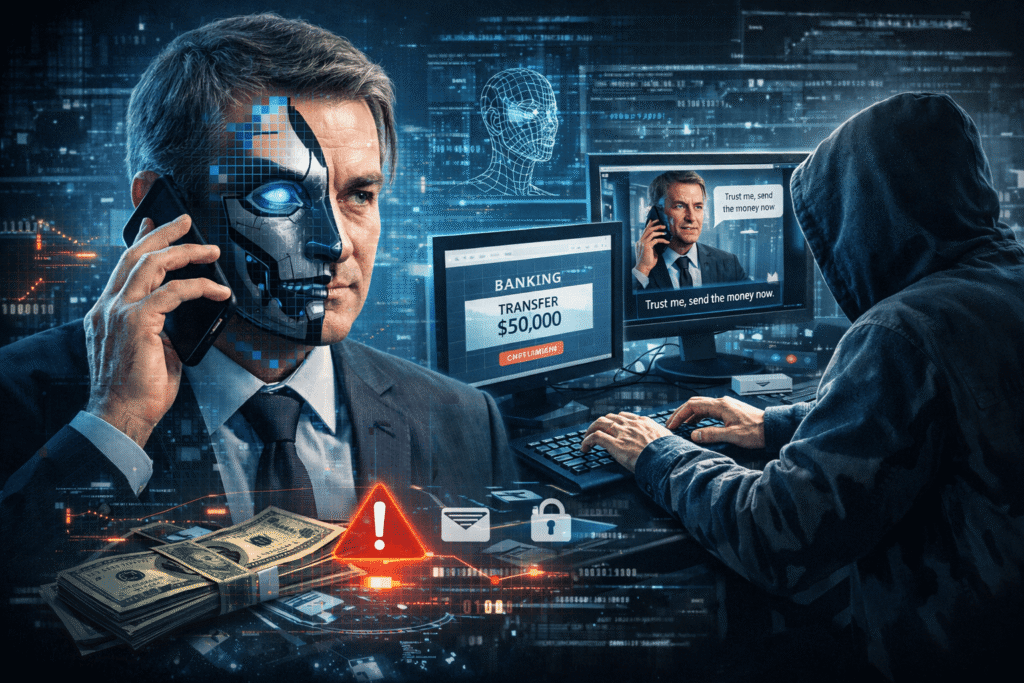
Deepfake scams in 2026 use AI-generated audio, video, and text to impersonate executives, colleagues, or financial institutions to defraud individuals and enterprises. The Arup deepfake video call attack cost $25.6 million. Key detection methods include liveness detection, digital watermarking, behavioral biometrics, and multi-factor verification of unexpected financial requests.
In February 2024, a finance employee at the multinational engineering firm Arup transferred HK$200 million — approximately USD $25.6 million — after being convinced by what appeared to be a video conference call with the company’s CFO and several colleagues. Every face on that call was a deepfake. No one on the call was real. The employee only discovered the fraud after contacting the firm’s head office. It was not a science fiction scenario — it was a Tuesday morning in Hong Kong.
Welcome to the era of deepfake scams. Artificial intelligence has handed cybercriminals a toolkit of unprecedented sophistication: voice cloning that can replicate a CEO from 30 seconds of audio, face-swapping technology that runs in real time on consumer hardware, and generative AI that produces convincing phishing content indistinguishable from legitimate corporate communication. In 2026, these tools are no longer experimental — they are industrialized.
This guide delivers a comprehensive, research-backed analysis of deepfake fraud in 2026: how the attacks are built, who is being targeted, the statistics that define the threat landscape, real enterprise case studies, and the detection and prevention strategies that are actually working. Whether you are a CISO, security analyst, risk officer, or business leader, this is the deepfake cybersecurity briefing you need.
What Are Deepfake Scams?
Deepfake scams are fraudulent schemes that use artificial intelligence technologies — including deepfake video and audio synthesis, large language models, voice cloning, and generative image tools — to deceive victims into transferring money, surrendering credentials, disclosing sensitive data, or taking actions that benefit the attacker. The defining characteristic of AI scams is synthetic authenticity: the fraudulent content is not merely convincing — in many cases, it is technically indistinguishable from legitimate communications even to trained human observers.
Unlike traditional fraud, which relies on social engineering skill, script-reading, or crude impersonation, AI scams automate and scale the convincing elements of deception. A single threat actor or organized criminal group can now simultaneously run thousands of personalized phishing campaigns, generate custom deepfake videos of executives on demand, clone voices from public social media audio, and respond dynamically to victim questions through AI chatbots — all with minimal human involvement.
How Deepfake Scams Differ from Traditional Scams
The gap between traditional and AI-powered fraud is not merely technological — it is categorical. Traditional social engineering scams depend on the attacker’s personal persuasion skills, language proficiency, and the victim’s inability to verify identity. AI scams eliminate several of those friction points simultaneously.
- Scale: Traditional scams are constrained by human bandwidth. AI enables mass personalization — attackers can generate individualized deepfake audio or text for thousands of targets in parallel.
- Authenticity: Voice cloning models trained on publicly available audio can reproduce a specific person’s voice with less than 30 seconds of source material. Video deepfakes now run in real time via commodity webcams.
- Evasion: AI-generated phishing content scores higher on spam filter bypass tests than human-written equivalents, according to research from IBM Security (2024).
- Iteration speed: When a deepfake scam approach is detected or reported, attackers can rapidly iterate — changing the synthetic identity, communication channel, or targeting criteria within hours.
How Deepfake Scams Work
Understanding how deepfake scam is operationally constructed is essential for building effective defenses. Modern AI scam campaigns follow a recognizable attack lifecycle, from target reconnaissance through synthetic content generation to the final social engineering execution.
The process typically begins with open-source intelligence (OSINT) gathering. Attackers scrape LinkedIn profiles to map corporate org charts, harvest audio from YouTube interviews or earnings calls for voice cloning, collect video footage from conference presentations for face synthesis, and extract email signatures and communication styles from leaked databases or phishing-acquired inboxes. The AI model is then trained — or more commonly, prompted — on this harvested material.
In the execution phase, attackers deploy the synthetic persona through the highest-trust channel available: a video conference call impersonating the CEO, a voice call impersonating IT support, or a WhatsApp message with the CFO’s cloned voice authorizing an urgent wire transfer. The “urgent and confidential” framing that has always been central to business email compromise (BEC) scams is now amplified by the apparent visual or auditory presence of a trusted authority figure.
The Deepfake Scam Toolchain
The commoditization of AI fraud tools has dramatically lowered the barrier to entry. The following technologies form the core toolchain used in deepfake scam operations as of 2026:
- Voice cloning engines: Tools such as ElevenLabs, Resemble AI, and numerous open-source alternatives can produce highly convincing voice replicas from minimal source audio. Subscription-based services make this accessible to non-technical actors.
- Real-time face swapping: Libraries built on diffusion models and GAN architectures enable live deepfake video during video calls, running on consumer-grade GPUs. These tools have been documented in active fraud campaigns since 2023.
- LLM-driven conversation: GPT-class models generate contextually appropriate responses during live impersonation calls, allowing the attacker to remain plausible even when asked unexpected questions.
- Synthetic document generation: AI tools produce convincing fake invoices, wire transfer instructions, board resolutions, and identity documents to support the social engineering narrative.
- Dark web-as-a-service: Organized cybercrime groups now offer deepfake fraud as a subscription service (DFaaS), lowering the technical barrier for less sophisticated attackers.
Types of Deepfake Scams
Deepfake fraud manifests across a spectrum of attack types, targeting individuals and organizations through different channels and with different objectives. The most prevalent categories in 2026 include:
- Deepfake scam video call fraud (BVC): Business video compromise — the evolution of BEC — uses real-time or pre-rendered deepfake video to impersonate executives during scheduled calls. The Arup attack is the defining case study.
- Voice cloning scams: Attackers clone the voice of a family member, executive, or known contact to request emergency fund transfers via phone. Reported cases have targeted both consumer victims (“virtual kidnapping” variants) and CFOs receiving CEO voice calls.
- AI-generated phishing: LLMs craft hyper-personalized spear-phishing emails that reference the victim’s real colleagues, recent projects, and corporate terminology harvested from OSINT sources.
- Deepfake scam identity fraud: Synthetic identities — combining AI-generated facial images with fabricated credentials — are used to pass KYC verification at financial institutions, enabling account opening, loan fraud, and money laundering.
- Synthetic media disinformation: AI-generated video or audio falsely attributing statements to executives, politicians, or public figures is weaponized for market manipulation, reputational attacks, or to destabilize organizations during M&A negotiations.
- Deepfake scam job candidate fraud: Fake candidates use deepfake scam video during remote job interviews to impersonate qualified individuals — gaining access to sensitive systems and insider knowledge. This is the core tactic in the DPRK campaign documented below.
Enterprise-Targeted Deepfake Scams
While consumer-facing deepfake scams grab headlines, enterprises face a more structured and higher-value threat. Corporate targets are attractive because the potential payout — a single fraudulent wire transfer, a stolen IP portfolio, or a compromised supply chain — can dwarf the returns from individual consumer fraud.
The most common enterprise attack vectors in 2026 are business video compromise (BVC), AI-enhanced supply chain fraud (where deepfake vendor communications alter payment details), insider threat augmentation (using AI to help a human insider avoid behavioral detection), and deepfake-assisted corporate espionage (where fake job candidates or conference attendees extract proprietary information).
Deepfake Scams by the Numbers: 2024–2026 Statistics
KEY STAT: The FBI’s Internet Crime Complaint Center (IC3) reported over $10.3 billion in business email compromise and related fraud losses in 2023 — and industry analysts project AI-augmented variants will account for more than 40% of BEC incidents by end of 2026 (Gartner, 2025).
The quantitative picture of deepfake scam in 2026 is alarming. The following statistics, drawn from government reports, industry research, and cybersecurity firm analyses, define the current threat landscape:
- Deloitte’s Center for Financial Services (2024) projected that generative AI could enable fraud losses of up to $40 billion in the United States alone by 2027, up from $12.3 billion in 2023.
- Sumsub’s Identity Fraud Report (2024) found a 244% increase in deepfake attempts between 2022 and 2024, with the financial services and crypto sectors bearing the highest volume.
- The Identity Theft Resource Center (2025) noted that AI-generated synthetic identity fraud now accounts for an estimated 85% of all identity fraud losses in the U.S. financial system.
- VMware’s Global Incident Response Threat Report found that 66% of security professionals reported encountering deepfakes used in cyberattacks, with a 13% year-over-year increase.
- Pindrop’s 2024 Voice Intelligence and Security Report documented a 350% increase in voice cloning fraud attempts on financial institutions’ call centers between 2022 and 2024.
- The average cost of a successful business video compromise attack in 2025 was estimated at $4.6 million, inclusive of direct financial losses and incident response costs (Cybersecurity Ventures, 2025).
- A 2025 survey by KPMG found that 74% of enterprise security leaders rated deepfake scam as a top-five emerging risk for their organizations — up from 38% in 2022.
Deepfake Scams in the Enterprise: Real-World Case Studies
Abstract statistics tell only part of the story. The following case studies — each representing a documented or officially reported incident — illustrate how deepfake AI scams operate in practice, what made them effective, and what they reveal about enterprise vulnerabilities.
Arup Deepfake Scam Video Call — $25.6 Million (2024)
In January 2024, a finance worker at the Hong Kong office of Arup — one of the world’s largest engineering consultancies — received what appeared to be a routine video conference invitation from the company’s UK-based CFO. The meeting involved a multi-party call with what appeared to be several other Arup executives. The finance worker was asked to execute a series of transfers totaling HK$200 million (approximately USD $25.6 million) to five different bank accounts.
Hong Kong Police confirmed in February 2024 that every individual on the video call — except the victim — was an AI-generated deepfake. The attackers had used publicly available footage of the executives from corporate events and media appearances to train the synthesis models. The employee had initially been skeptical upon receiving the request by email but was reassured by the apparent visual confirmation of the executives’ identities during the video call.
The case exposed a fundamental vulnerability in enterprise authentication: the assumption that visual or auditory confirmation of identity provides meaningful verification. It also established business video compromise as a high-value attack category demanding dedicated countermeasures.
DPRK Deepfake Scam Job Candidates
The U.S. Department of Justice and the FBI have issued multiple advisories documenting a systematic campaign by North Korean IT workers — operating on behalf of the regime’s weapons financing programs — to obtain remote employment at Western technology companies using deepfake -assisted video interviews and fabricated credentials.
The campaign, which escalated significantly through 2024 and 2025, involves North Korean operatives using deepfake scam video filters during job interviews to impersonate other individuals, using AI-generated or stolen identities to pass background checks, and leveraging “laptop farm” facilitators in the U.S. to launder employment payments back to Pyongyang. Once hired, these individuals gain insider access to source code repositories, internal systems, and sensitive business data.
The FBI estimated in its 2024 advisory that DPRK IT workers had generated hundreds of millions of dollars for North Korea’s weapons programs through this scheme. Multiple Fortune 500 companies — including at least one major cybersecurity firm, KnowBe4, which publicly disclosed the incident in 2024 — confirmed hiring individuals who were later identified as DPRK operatives.
Check Point “Truman Show” Investment Fraud
Check Point Research documented an elaborate deepfake investment fraud campaign they named “The Truman Show” after the 1998 film depicting a manufactured reality. The operation used AI-generated deepfake videos of prominent business figures — including tech executives and financial commentators — falsely endorsing fraudulent cryptocurrency investment platforms.
The synthetic endorsement videos were distributed across social media platforms and appeared professionally produced, with the deepfake subjects delivering scripted investment pitches. Victims who clicked through to the fraudulent platforms were subjected to further AI-assisted social engineering — including chatbot advisors and AI-generated performance dashboards showing fabricated investment returns — before being induced to deposit funds that were subsequently stolen.
Check Point noted that the campaign demonstrated the industrialization of deepfake : the production pipeline was sufficiently automated that new deepfake celebrity endorsement videos could be generated within 24–48 hours of a new public figure becoming topically relevant.
Industry-Specific Targeting Patterns
Analysis of documented deepfake scam incidents reveals clear industry targeting patterns. Financial services and banking represent the highest-value target sector, accounting for an estimated 45% of enterprise deepfake fraud attempts by value. Cryptocurrency exchanges face concentrated deepfake KYC bypass attacks. Technology companies are disproportionately targeted by the DPRK job candidate campaign due to remote work norms and high-value IP access. Healthcare organizations face deepfake vendor scam and insurance billing manipulation. Energy and critical infrastructure companies have been targeted in deepfake -assisted corporate espionage campaigns.
Detecting and Preventing AI Scams
Effective deepfake scam detection in 2026 requires a layered defense strategy that combines technical controls, process redesign, and human awareness — because no single control is sufficient against the full spectrum of AI-powered fraud.
Technical deepfake detection methods have advanced significantly but remain imperfect. The most reliable currently deployed approaches include:
- Liveness detection: Active liveness checks — which require users to perform unpredictable physical actions — are more resistant to pre-rendered deepfake attacks than passive biometric checks. Leading identity verification platforms now deploy 3D depth sensing and infrared imaging to defeat face-swap overlays.
- Digital watermarking and C2PA: The Coalition for Content Provenance and Authenticity (C2PA) standard — backed by Adobe, Microsoft, Google, and major camera manufacturers — embeds cryptographically signed provenance metadata into media at point of capture. Content lacking valid C2PA provenance should be treated as unverified.
- Behavioral biometrics: Analyzing micro-behavioral patterns — typing cadence, mouse dynamics, gait during video calls, eye movement patterns — can flag anomalies consistent with deepfake overlays or scripted AI responses.
- Spectral and temporal analysis: AI-based deepfake detection models analyze video at the pixel and frame level, identifying compression artifacts, unnatural blinking patterns, facial boundary inconsistencies, and GAN fingerprints that indicate synthetic generation.
- Voice biometric anti-spoofing: Dedicated voice liveness detection systems — deployed in call center authentication workflows — analyze phoneme timing, breathing patterns, and acoustic artifacts to identify cloned or synthesized voice audio.
MITRE ATT&CK Mapping for AI Scam Threats
The MITRE ATT&CK framework provides a structured taxonomy for mapping AI scam attack techniques to enterprise threat models. Key technique mappings for deepfake fraud include:
- T1598 — Phishing for Information: AI-enhanced spear-phishing used in the reconnaissance phase to harvest credentials, org chart data, and communication patterns.
- 003 — Phishing via Service: Deepfake video and voice calls delivered through legitimate communication platforms (Zoom, Teams, WhatsApp) rather than email, bypassing email security controls.
- T1534 — Internal Spearphishing: Once a deepfake attack has compromised one account or identity, AI-generated messages sent from that identity to internal colleagues.
- T1656 — Impersonation: Direct impersonation of executives, vendors, or IT personnel using synthetic audio or video — the core technique in BVC attacks.
- 002 — Establish Accounts (Social Media): Creating deepfake social media profiles of executives or employees used as source material for ongoing fraud campaigns.
Regulatory Landscape for AI Fraud
The regulatory environment surrounding deepfake fraud is evolving rapidly, though significant jurisdictional gaps remain in 2026. Key developments include:
- EU AI Act (2024–2026): Classifies certain deepfake uses as high-risk AI applications requiring transparency disclosures. Mandates that synthetic media impersonating real persons be labeled. Penalties of up to 6% of global annual revenue for non-compliance by covered entities.
- S. DEEPFAKES Accountability Act: Proposed federal legislation requiring disclosure of AI-generated media used in political or commercial contexts. As of 2026, over 20 U.S. states have enacted deepfake-specific criminal statutes.
- UK Online Safety Act: Requires platforms to proactively detect and remove non-consensual deepfake intimate imagery and financially motivated deepfake fraud content.
- FinCEN Guidance on Synthetic Identity Fraud: The U.S. Financial Crimes Enforcement Network issued guidance requiring financial institutions to implement enhanced due diligence for synthetic identity detection, including AI-based KYC verification.
Modern Approaches to AI Scam Defense
Organizations that have successfully reduced their exposure to deepfake fraud in 2026 share a common characteristic: they have moved beyond awareness training and reactive detection toward systematic process controls that make deepfake attacks structurally harder to execute — regardless of how convincing the synthetic content is.
The most effective enterprise defense postures combine the following elements:
- Out-of-band verification protocols: Any unexpected financial request, credential change, or sensitive data disclosure — regardless of apparent channel — must be verified through a separate, pre-established communication path. The specific callback number or secure messaging channel should be pre-agreed and documented, not taken from the communication being verified. This single control would have prevented the Arup attack.
- Zero-trust identity verification: Implement continuous authentication rather than point-in-time identity checks. Zero-trust architectures that require re-verification for high-value actions — combined with hardware security keys and phishing-resistant MFA — significantly raise the cost of deepfake impersonation attacks.
- Dedicated deepfake detection tooling: Deploy AI-powered detection platforms that analyze video call feeds in real time for deepfake indicators. Solutions from Pindrop (voice), Reality Defender, Intel’s FakeCatcher, and Microsoft’s Azure AI Content Safety offer enterprise-grade detection capabilities with documented accuracy rates above 90% on current generation synthetic media.
- Executive digital twin protection: Proactively manage the public digital footprint of senior executives — limiting publicly available high-quality audio and video that can serve as cloning source material. Work with executives to minimize unnecessary media appearances and implement digital watermarking of all official video content.
- Tabletop exercises and red-team simulations: Conduct regular deepfake-specific tabletop exercises in which a red team uses commercially available deepfake tools to attempt to social-engineer finance, IT, or HR personnel. These exercises systematically identify process vulnerabilities before adversaries do.
- Vendor and supply chain verification: Apply enhanced verification protocols to any communication requesting changes to payment details, banking information, or delivery addresses — regardless of whether the communication appears to originate from a known and trusted vendor.
- AI literacy and deepfake awareness training: Ensure all personnel who handle financial transactions, sensitive data, or access credentials receive regular, updated training on deepfake fraud tactics — including demonstration of current deepfake quality to calibrate accurate threat perception.
Conclusion
Deepfake scams represent the most significant qualitative shift in the social engineering threat landscape since the invention of email phishing. The combination of synthetic audio, video, and text generated by rapidly improving AI models has fundamentally altered the trust calculus that human beings — and the organizations they work within — rely on when making high-stakes decisions.
The $25.6 million Arup attack, the DPRK job candidate campaign, and the industrialized investment fraud operations documented by researchers are not outliers. They are early data points in a trend line that points steeply upward. Gartner predicts that by 2026, 30% of enterprise identity verification and authentication solutions will be inadequate against AI-generated synthetic identity attacks — a prediction that, given current trajectories, appears conservative.
The appropriate response is neither panic nor paralysis. It is systematic, intelligence-led security program enhancement that specifically addresses the unique properties of AI-generated fraud: its ability to exploit visual and auditory trust, its capacity for mass personalization, and its iterative improvement speed. Organizations that invest in out-of-band verification processes, dedicated detection tooling, zero-trust architectures, and regular adversarial simulation will be substantially better positioned to absorb the escalating deepfake threat than those that treat awareness training as a sufficient response.
The deepfake arms race between fraudsters and defenders is now fully underway. In 2026, the question is not whether your organization will encounter a deepfake scam attempt — it is whether your defenses will be sufficient when that attempt arrives.
FAQs
What are deepfake scams and how do they work?
Deepfake scams use AI-generated synthetic audio, video, or imagery to impersonate trusted individuals — executives, family members, or known contacts — in order to deceive victims into transferring money, surrendering credentials, or disclosing sensitive information. They work by exploiting the human tendency to trust sensory confirmation of identity, combining OSINT-sourced personalization with AI synthesis tools to create fraudulent communications that are difficult to distinguish from legitimate ones.
How can I detect a deepfake video call or voice call?
Warning signs of deepfake video calls include unnatural blinking patterns or facial boundary inconsistencies, audio-video synchronization delays, unusual resistance to unexpected questions, and unusual urgency combined with requests for financial action or credential sharing. For voice calls, listen for slightly robotic cadence, absence of natural breathing sounds, or inconsistent emotional tone. Critically: always verify unexpected financial requests through a separate, pre-established communication channel regardless of how convincing the caller appears.
What industries are most at risk from deepfake scam?
Financial services, banking, and cryptocurrency exchanges face the highest volume of deepfake KYC bypass and wire fraud attacks. Technology companies are disproportionately targeted by DPRK-linked job candidate fraud campaigns. Professional services firms (legal, consulting, engineering) with significant wire transfer activity — such as Arup — face high BVC risk. Healthcare and insurance organizations face deepfake-assisted billing fraud.
Are there laws against deepfake scams?
Yes, though the regulatory landscape is fragmented. In the United States, over 20 states have deepfake-specific criminal statutes, and deepfake fraud falls under existing wire fraud and identity theft statutes at the federal level. The EU AI Act (2024) mandates transparency disclosures for synthetic media. The UK Online Safety Act targets deepfake fraud content on platforms. International enforcement remains challenging due to jurisdictional complexity and the prevalence of offshore threat actors.
What tools are available to detect deepfakes?
Enterprise-grade deepfake detection solutions include Reality Defender (video and audio), Pindrop Pulse (voice authentication anti-spoofing), Intel FakeCatcher (real-time video analysis), Microsoft Azure AI Content Safety, and Sensity AI. For identity verification contexts, providers including iProov, Onfido, and Jumio have integrated liveness detection specifically designed to defeat deepfake attacks. The C2PA content provenance standard provides a complementary approach by authenticating media at point of capture.
How can businesses protect against deepfake CEO fraud?
The most effective protection against deepfake CEO fraud (business video compromise) is process-based rather than technology-based: establish a mandatory out-of-band verification protocol for all financial transfers above a defined threshold, regardless of the apparent identity of the requester. This means a pre-agreed callback number or secure channel — not the contact information provided in the suspicious communication. Supplement this with zero-trust MFA for payment authorization, regular deepfake simulation exercises, and executive digital footprint management.